
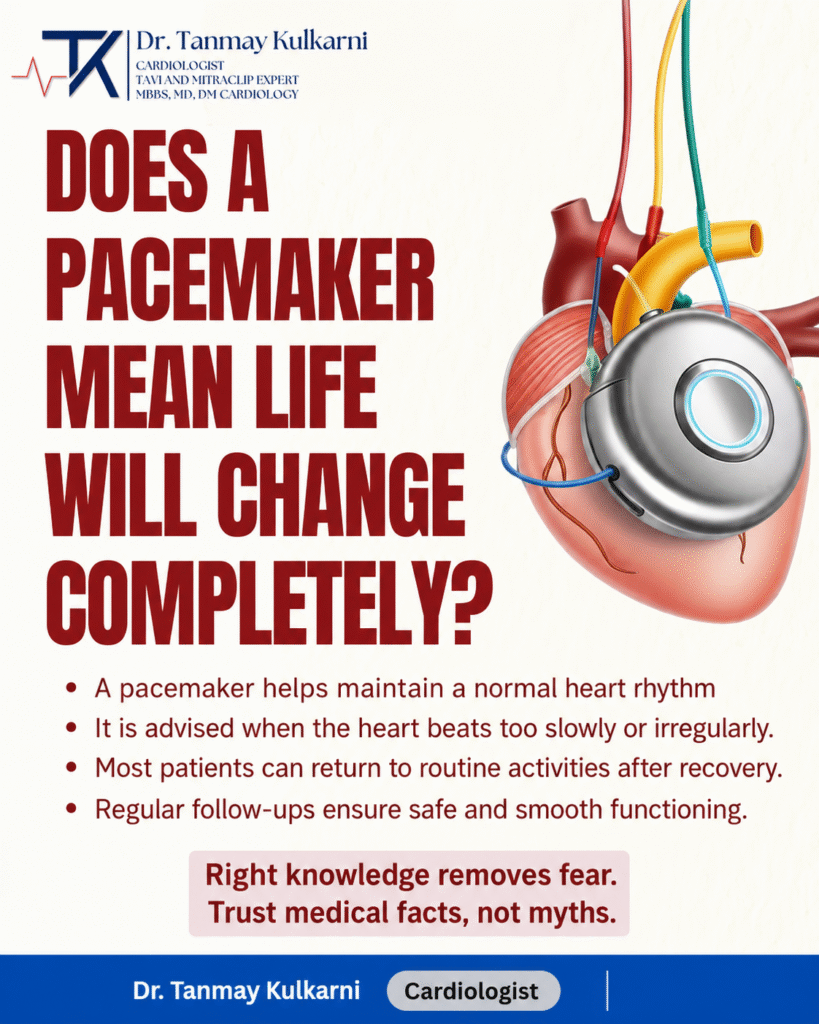
Being advised to get a pacemaker can naturally raise questions. Will you be able to work normally? Can you exercise? Will you have to change your lifestyle? Does having a pacemaker mean that your heart is becoming weaker?
Understanding how a pacemaker works can remove many of these uncertainties. For patients seeking a Cardiologist in Pune, Dr. Tanmay Kulkarni provides evaluation and guidance for heart rhythm disorders and other cardiovascular conditions.
A pacemaker is designed to help regulate certain abnormal heart rhythms. For many patients, the aim of treatment is to improve symptoms related to a slow or unreliable heartbeat and help them return safely to everyday activities following appropriate recovery.
What Is a Pacemaker?
A pacemaker is a small electronic medical device usually implanted beneath the skin in the upper chest. It is connected to the heart through one or more leads in traditional systems, although certain newer pacemakers may be leadless.
The device monitors the heartbeat. When it detects that the heart is beating too slowly or when pacing is otherwise needed, it can send small electrical impulses to help maintain an appropriate heart rate.
Importantly, a pacemaker does not replace the heart. Instead, it supports the heart’s electrical system when the natural rhythm is too slow or certain electrical signals are not being transmitted properly.
Why Might Someone Need a Pacemaker?
The heart has its own electrical conduction system responsible for coordinating each heartbeat. Problems with this system can sometimes cause the heart to beat unusually slowly or lead to pauses in the rhythm.
Conditions that may lead a cardiologist to consider pacemaker implantation include certain forms of bradycardia, sinus node dysfunction and heart block.
Patients with these rhythm disturbances may experience symptoms such as:
- Unexplained tiredness
- Dizziness or light-headedness
- Fainting or near-fainting episodes
- Shortness of breath
- Reduced ability to exercise
- Weakness or unusual fatigue
However, these symptoms can have many different causes. Having one or more of them does not automatically mean that a pacemaker is required.
Does Having a Pacemaker Completely Change Your Life?
For many people, life after a pacemaker does not mean giving up normal day-to-day activities.
After the initial healing period and depending on their underlying heart condition, many patients can gradually return to work, walking, travelling, household activities and suitable forms of exercise.
There are usually some temporary restrictions immediately after pacemaker surgery, particularly regarding the arm on the side of implantation, wound care and strenuous activity. Your cardiologist will advise when different activities can safely be resumed.
Recovery recommendations are individualized, so another patient’s experience should not be used as your own recovery timeline.
What Happens After Pacemaker Implantation?
Follow-up is an important part of pacemaker care.
During follow-up appointments, the device can be checked to assess its function, battery status and programmed settings. The cardiologist may also evaluate the patient’s symptoms and overall cardiovascular health.
Modern pacemakers have batteries designed to function for several years, but their lifespan varies depending on the device, its settings and how frequently pacing is required. Regular monitoring allows the medical team to plan appropriately when battery replacement eventually becomes necessary.
Can You Exercise With a Pacemaker?
Many people can return to physical activity after receiving medical clearance.
Walking and other suitable exercises may gradually be introduced depending on recovery and the patient’s underlying condition. During the early healing period, however, patients are generally advised to follow restrictions provided by their treating team.
People who participate in strenuous exercise or contact sports should discuss their activities with their cardiologist because recommendations can differ.
The objective is not simply to restrict activity but to help patients return to an appropriate and safe level of physical independence.
What About Mobile Phones and Electronic Devices?
This is a common concern among patients.
Most everyday household electronics can generally be used safely when recommended precautions are followed. However, strong magnetic or electromagnetic fields can potentially interfere with some cardiac devices.
Patients should follow the instructions provided for their specific pacemaker and inform healthcare professionals about the device before certain medical procedures or scans.
It is also useful to carry the pacemaker identification card provided after implantation.
Pacemaker and MRI: What Should Patients Know?
Not every pacemaker has the same MRI compatibility.
Many newer cardiac devices are designed to be MRI-conditional, meaning an MRI may be possible when specific safety requirements are met. Compatibility depends on the pacemaker system and clinical circumstances.
Therefore, patients should always tell the radiology and cardiology teams that they have a pacemaker before undergoing an MRI rather than assuming that a scan is automatically safe or prohibited.
Regular Follow-Ups Remain Important
Feeling well after implantation does not mean follow-up can be stopped.
Cardiac follow-up allows doctors to monitor device performance while also keeping track of the patient’s broader heart health. Depending on the device, remote monitoring may also be available.
Patients should contact their healthcare team if they develop concerning symptoms such as unexplained fainting, persistent dizziness, worsening breathlessness, unusual palpitations, or redness, swelling, discharge or increasing pain around the implantation site.
The Right Information Can Reduce Pacemaker Anxiety
A recommendation for a pacemaker can initially sound intimidating, but it should be understood in the context of the heart rhythm problem it is intended to manage.
Every patient’s situation is different. The need for a pacemaker, the type of device, recovery recommendations and long-term monitoring should be decided after appropriate cardiovascular assessment.
Dr. Tanmay Kulkarni evaluates heart rhythm disorders, cardiovascular symptoms and related heart conditions, helping patients understand their diagnosis and available treatment options.
When it comes to a pacemaker, reliable medical information is far more useful than myths or assumptions. Asking questions, understanding your device and attending scheduled follow-ups can help you approach life after implantation with greater clarity and confidence.