
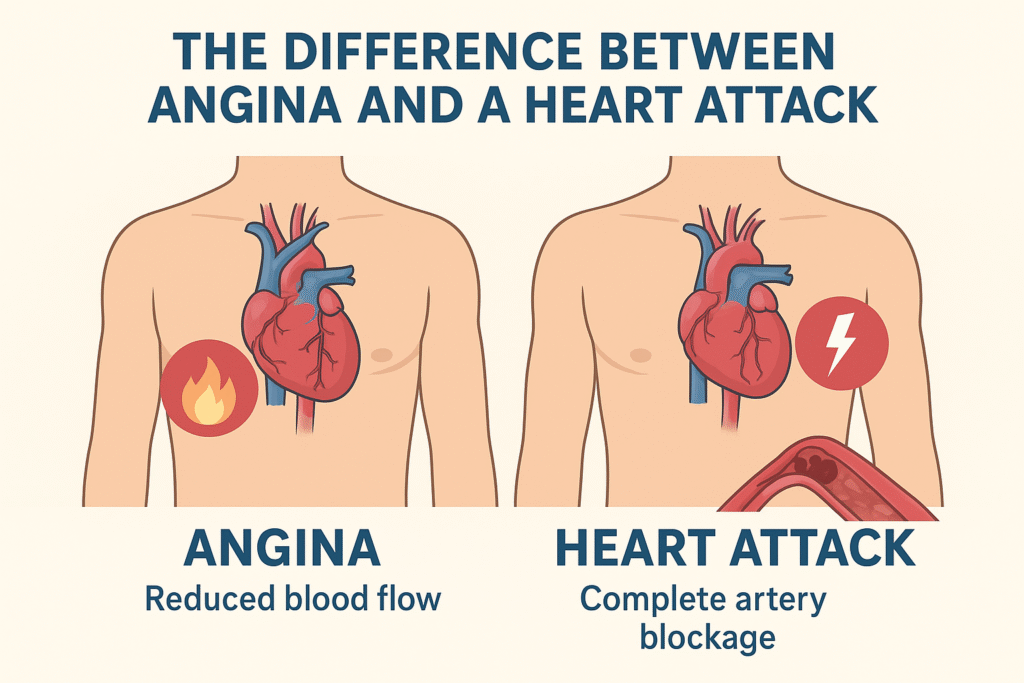
Heart-related symptoms can feel confusing—especially when chest discomfort appears suddenly. Many people assume every chest pain is a heart attack, but that’s not always true. In fact, a common condition called angina can cause similar discomfort yet has different implications. Understanding the difference between angina and a heart attack can help you seek timely care and protect your heart health. Here’s a clear breakdown explained in simple words.
What Is Angina?
Angina is not a disease by itself—it is a warning sign that your heart is not receiving enough oxygen-rich blood. This usually happens because one or more coronary arteries have become narrowed due to plaque build-up. When your heart works harder—during exercise, emotional stress, or even after a heavy meal—the reduced blood flow triggers chest discomfort.
People describe angina as:
- Pressure or tightness in the chest
- Burning or heaviness
- Pain that may spread to the jaw, shoulder, or arm
Angina usually lasts a few minutes, and symptoms often improve with rest or medication like nitrates. While angina is not immediately life-threatening, it is a serious indicator of underlying heart disease. Ignoring it can eventually lead to a heart attack.
Types of Angina
- Stable Angina:
Triggered by predictable situations like walking uphill or stress. Symptoms improve with rest. - Unstable Angina:
More dangerous. It occurs even at rest, lasts longer, and does not improve quickly. This requires emergency medical attention because it may be a sign of an impending heart attack. - Variant (Prinzmetal’s) Angina:
Caused by temporary coronary artery spasms. Usually happens at rest and can be severe.
What Is a Heart Attack?
A heart attack (myocardial infarction) happens when blood flow to a part of the heart is completely blocked, usually by a blood clot formed on top of a plaque rupture. Without blood, that part of the heart muscle begins to die within minutes. This is a medical emergency and requires immediate treatment to save heart muscle and life.
Common symptoms of a heart attack include:
- Intense chest pain or pressure lasting more than 10–15 minutes
- Pain radiating to the arm, back, jaw, or neck
- Breathlessness
- Cold sweats
- Nausea or vomiting
- Feeling faint or uneasy
A heart attack does NOT improve with rest, and waiting too long to seek help can cause permanent heart damage.
Key Differences Between Angina and a Heart Attack
| Feature | Angina | Heart Attack |
| Cause | Reduced blood flow due to narrowed arteries | Complete blockage of artery |
| Pain Duration | Few minutes | More than 10–15 minutes |
| Relief | Improves with rest/medication | No relief with rest |
| Severity | Warning sign but not usually fatal | Life-threatening emergency |
| Heart Muscle Damage | No permanent damage | Permanent damage if untreated |
Why It’s Important to Know the Difference
Recognizing the early signs of angina gives you a chance to act before a heart attack occurs. Timely evaluation by a cardiologist can prevent complications. On the other hand, confusing a heart attack for simple chest discomfort can delay treatment and increase the risk of severe heart failure or sudden cardiac arrest.
If you experience chest pain that is new, unusual, or lasting longer than normal, you should seek medical help immediately.
When to See a Cardiologist?
Consult a Cardiologist in Baner if:
- You experience frequent chest discomfort
- Pain spreads to your shoulder, jaw, or back
- You have risk factors like diabetes, high BP, high cholesterol, or smoking
- You feel breathless or feel fatigued easily
- You have a family history of heart disease
A timely evaluation can include tests such as ECG, 2D Echo, TMT or advanced angiography to determine the severity of the blockage.
How Dr. Tanmay Kulkarni Can Help
As an experienced Cardiologist in Baner, Dr. Tanmay Kulkarni specializes in diagnosing and treating conditions like angina, coronary artery disease, and heart attacks. With advanced cardiac evaluation and personalised treatment plans, he ensures patients receive accurate diagnosis, timely interventions, and long-term heart health management.
Whether you’re experiencing mild chest discomfort or have been diagnosed with heart disease, early consultation can make all the difference.
Final Thoughts
Angina and a heart attack may feel similar, but they are very different in terms of severity and urgency. Angina is a warning sign that your heart needs help, while a heart attack is a medical emergency that requires immediate treatment. Understanding these differences helps you respond quickly and make informed decisions about your health.
If you or your loved one has persistent chest pain, don’t ignore the signs. Consult a heart specialist before it’s too late. For expert cardiac care, reach out to Dr. Tanmay Kulkarni – trusted Cardiologist in Baner.
 Select an element to maximize. Press ESC to cancel.