
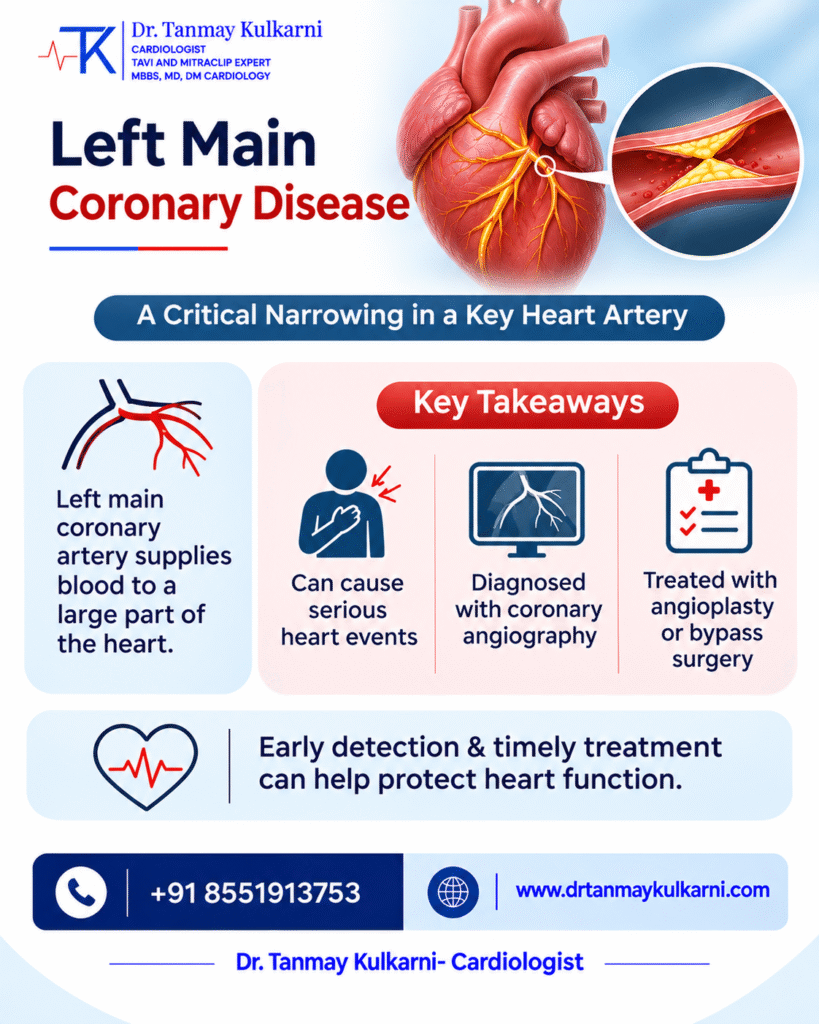
The coronary arteries supply oxygen-rich blood to the heart muscle. Among them, the left main coronary artery has a particularly important role because it supplies blood to a large portion of the heart through its major branches. Narrowing in this artery can therefore have significant implications for heart function and requires careful clinical assessment.
Left Main Coronary Disease refers to significant narrowing or blockage involving the left main coronary artery. Because of the amount of heart muscle supplied by this vessel, diagnosis and treatment planning require a detailed understanding of the patient’s symptoms, coronary anatomy and overall cardiovascular health.
Dr. Tanmay S. Kulkarni, Cardiologist in Baner, Pune, evaluates patients with suspected or known coronary artery disease using clinical assessment and appropriate cardiac investigations. Treatment decisions are individualised according to the patient’s condition rather than based on a single test result.
Why Is the Left Main Coronary Artery Important?
The left main coronary artery is a short but strategically important blood vessel. It generally divides into the left anterior descending artery and the left circumflex artery. These branches supply blood to substantial areas of the heart muscle.
When significant narrowing affects this vessel, blood flow to these downstream regions can be reduced, particularly when the heart requires more oxygen during physical activity.
This is why significant disease involving this artery deserves careful evaluation and appropriate treatment planning.
What Causes Narrowing?
Atherosclerosis is one of the most common causes of coronary artery narrowing. It develops when fatty deposits, cholesterol, inflammatory cells and other substances accumulate within the arterial wall.
Several cardiovascular risk factors can contribute to the development and progression of atherosclerosis, including:
- High blood pressure
- Diabetes
- High cholesterol
- Smoking or tobacco exposure
- Obesity
- Physical inactivity
- Increasing age
- Family history of cardiovascular disease
However, the presence of risk factors does not mean that a person will necessarily develop significant coronary disease. Individual risk varies, which is why appropriate cardiovascular assessment is important.
What Symptoms Can Occur?
Symptoms can vary considerably between individuals.
Some people may experience chest discomfort, especially during physical activity or emotional stress. The sensation may be described as pressure, heaviness, tightness or discomfort rather than sharp pain.
Other possible symptoms include:
- Breathlessness during exertion
- Unusual fatigue
- Reduced exercise tolerance
- Sweating
- Dizziness
- Discomfort that may spread toward the arm, shoulder, neck, jaw or back
Some people, particularly those with diabetes or other medical conditions, may have less typical symptoms or even minimal symptoms.
New, severe or persistent chest discomfort, especially when accompanied by breathlessness, sweating, fainting or significant weakness, requires urgent medical attention.
How Is It Diagnosed?
Diagnosis involves more than simply identifying symptoms. A cardiologist considers the patient’s medical history, physical examination, cardiovascular risk factors and results of appropriate investigations.
An ECG may provide information about the heart’s electrical activity and can sometimes show changes associated with reduced blood supply or previous heart injury.
An echocardiogram can assess heart structure, valve function and pumping performance.
When coronary artery disease is suspected or already known, coronary angiography can provide detailed information about the location and severity of arterial narrowing.
In selected patients, additional cardiac imaging or physiological assessment may be considered to better understand the significance of a coronary lesion.
How Is Treatment Decided?
Treatment depends on several factors, including the severity and location of narrowing, symptoms, heart function, other coronary artery disease, overall health and the patient’s individual risk.
Medical management may be appropriate as part of comprehensive cardiovascular care. Depending on the clinical situation, treatment may include medicines for cholesterol, blood pressure, diabetes, prevention of blood clots or control of symptoms.
Lifestyle measures also remain important. A heart-healthy eating pattern, regular physical activity appropriate for the individual’s condition, avoidance of tobacco and management of cardiovascular risk factors can support long-term heart health.
When Is an Intervention Considered?
When significant narrowing is identified, the cardiology team may consider revascularisation to improve blood flow to the heart muscle.
Two important approaches are coronary angioplasty and coronary artery bypass surgery.
During angioplasty, a catheter-based procedure is used to treat the narrowed artery, often with placement of a stent when appropriate. In selected complex lesions, specialised techniques may be required to prepare heavily calcified arteries before stent placement.
Bypass surgery creates an alternative route for blood to reach the heart muscle beyond the narrowed section.
The choice between different treatment approaches depends on coronary anatomy, the extent of disease, heart function, associated medical conditions and the overall clinical situation.
Why Detailed Treatment Planning Matters
Disease involving an important coronary artery should not be approached with a one-size-fits-all strategy.
Detailed evaluation helps the cardiology team understand the anatomy and determine whether medication, catheter-based treatment, surgery or a combination of approaches may be appropriate.
In complex coronary cases, advanced imaging and interventional techniques can support treatment planning. The goal is to select an approach that addresses the patient’s specific anatomy while considering both immediate and long-term cardiovascular care.
Heart Care in Baner, Pune
Dr. Tanmay S. Kulkarni provides cardiology consultation and interventional cardiac care in Pune.
Patients with recurring chest discomfort, breathlessness, reduced exercise tolerance or other concerning symptoms should discuss them with a qualified healthcare professional.
Coronary artery disease can vary significantly from one person to another. Early assessment, appropriate investigation and individualised treatment planning can help guide better-informed decisions about cardiovascular care.
The most appropriate treatment is determined after considering the complete clinical picture rather than relying on symptoms, a single investigation or a single treatment option alone.