
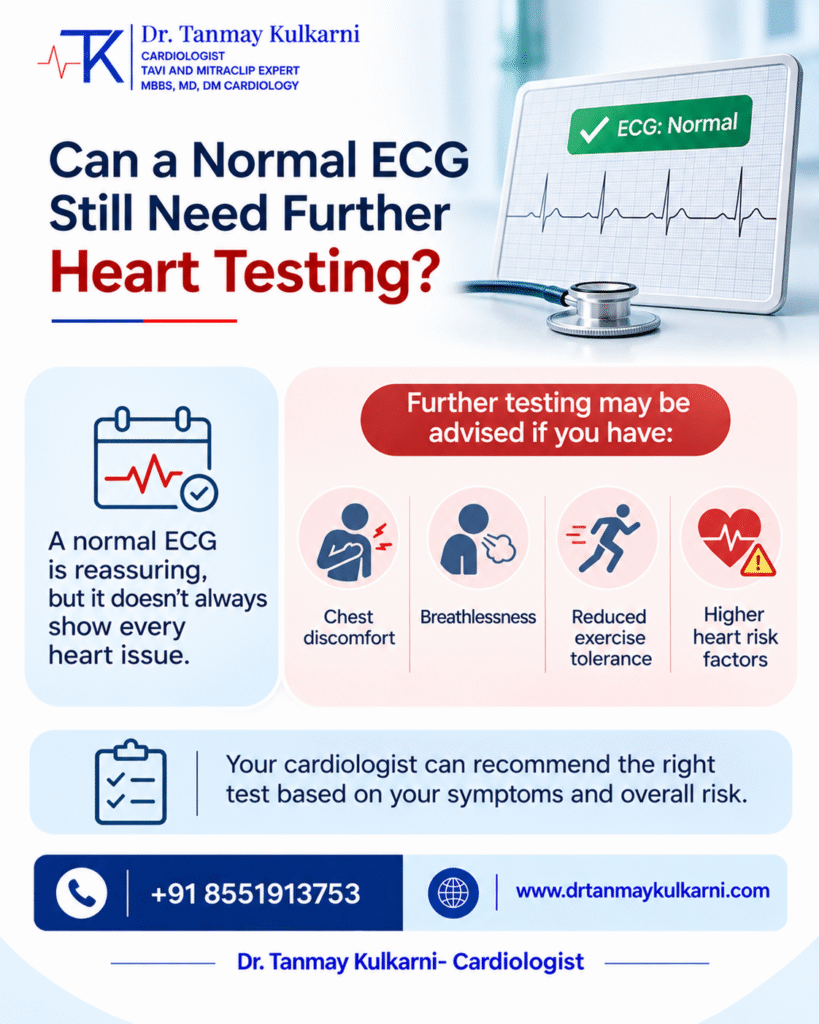
An electrocardiogram, commonly known as an ECG, is one of the most widely used tests for evaluating the heart. It records the electrical activity of the heart and can provide useful information about heart rhythm, heart rate and certain electrical abnormalities. However, an ECG represents the heart’s electrical activity during a particular period of time. It does not provide a complete picture of every aspect of heart health.
This means that a reassuring ECG result does not always mean that no further cardiac evaluation is required. The need for additional testing depends on symptoms, medical history, cardiovascular risk factors and what the doctor is trying to investigate.
Dr. Tanmay S. Kulkarni, Cardiologist in Baner, Pune, evaluates patients based on their individual symptoms and overall clinical picture before recommending further cardiac investigations.
What Does an ECG Actually Show?
An ECG records the electrical signals responsible for the heartbeat. It can help doctors assess the heart’s rhythm and identify certain electrical abnormalities.
An ECG may provide information about:
- Heart rate and rhythm
- Certain abnormal heart rhythms
- Electrical conduction problems
- Some patterns associated with reduced blood supply to the heart
- Certain changes related to previous cardiac events
The test is quick, commonly available and generally painless. However, it has limitations. Some heart problems may not produce detectable changes on a resting ECG, particularly when the issue occurs intermittently or becomes apparent only during physical activity.
This is one reason why doctors may consider additional investigations when symptoms continue despite a normal ECG.
Why Can Further Testing Be Needed?
A normal ECG can be reassuring, but it should always be interpreted in the context of the patient’s symptoms and risk profile.
For example, a person experiencing repeated chest discomfort may require additional assessment even if the resting ECG does not show an obvious abnormality. Similarly, someone experiencing breathlessness during exercise may need an investigation that evaluates how the heart performs under stress.
The objective is not to perform unnecessary tests. Instead, the goal is to select the appropriate investigation that answers the specific clinical question.
When Might a Doctor Recommend More Evaluation?
Further cardiac testing may be considered when symptoms or risk factors suggest that additional information is needed.
Some situations include:
Persistent chest discomfort:
New, recurrent or unexplained chest discomfort may require further evaluation, particularly when other cardiovascular risk factors are present.
Breathlessness:
Shortness of breath can have several causes. When a cardiac cause is suspected, an echocardiogram or other appropriate investigation may provide additional information.
Reduced exercise tolerance:
If activities that were previously comfortable now cause unusual fatigue or breathlessness, a doctor may consider testing that evaluates cardiac performance during exertion.
Palpitations:
A routine ECG may not capture an intermittent rhythm disturbance if the abnormal rhythm is not occurring during the test. In such cases, longer-duration rhythm monitoring may sometimes be considered.
Higher cardiovascular risk:
People with factors such as diabetes, high blood pressure, high cholesterol, smoking history or a significant family history may require a broader assessment depending on their individual circumstances.
What Tests May Be Considered After an ECG?
There is no single test that is appropriate for everyone. The next investigation depends on the symptoms and suspected condition.
An echocardiogram uses ultrasound to examine the heart’s chambers, valves, muscle movement and pumping function. It can provide structural information that an ECG cannot.
A stress test evaluates the heart while the patient exercises or undergoes another form of controlled stress. It can provide information about how the cardiovascular system responds when the heart has to work harder.
In selected situations, doctors may recommend longer-term rhythm monitoring to identify intermittent irregular heartbeats.
Advanced cardiac imaging may also be considered when more detailed information about the heart or coronary arteries is required.
Can an ECG Be Normal During a Heart Problem?
A resting ECG may not detect every cardiac problem. Some abnormalities are intermittent, while others become more evident when the heart is under physical stress.
This is particularly important when symptoms occur at specific times but are absent during the ECG examination.
For example, if a person experiences palpitations only occasionally, the rhythm may be normal by the time they reach the clinic. Similarly, certain problems may require assessment through imaging or exercise-based testing rather than an ECG alone.
Therefore, the ECG result should be considered as one part of a complete cardiac assessment.
Should You Be Concerned About a Normal ECG?
A normal ECG is generally reassuring, but it should not be interpreted in isolation.
If symptoms have resolved and there are no significant risk factors, a doctor may decide that no immediate additional testing is necessary. On the other hand, persistent or unexplained symptoms may justify further assessment.
Patients should avoid interpreting an ECG report on their own. The significance of an ECG finding depends on symptoms, medical history, physical examination and other relevant information.
When Should You Seek Medical Attention?
Certain symptoms require prompt medical attention regardless of a previous normal ECG.
Seek urgent medical care if you experience severe or persistent chest discomfort, significant breathlessness, fainting, sudden weakness or other symptoms that may indicate an acute cardiac problem.
For non-emergency symptoms that continue or repeatedly return, arranging a medical consultation can help determine whether further evaluation is appropriate.
Cardiac Evaluation in Baner, Pune
Dr. Tanmay S. Kulkarni provides cardiac consultation and interventional cardiology care in Pune. His Google Business Profile is listed as Dr. Tanmay S Kulkarni | Cardiologist in Pune | TAVR | Mitra Clip Specialist | TAVI Expert in Maharashtra | Baner.
Patients with ongoing chest discomfort, breathlessness, palpitations, reduced exercise tolerance or other cardiovascular concerns can discuss their symptoms with a qualified cardiologist.
The important point is that cardiac testing should be guided by the patient’s individual situation. An ECG is an important and useful investigation, but it is only one component of heart evaluation.
Additional testing is not automatically required after every normal ECG. However, when symptoms, risk factors or clinical findings indicate that more information is needed, appropriate investigations can help provide a clearer understanding of heart health.
Understanding what an ECG can and cannot show can help patients make informed decisions about their cardiovascular care and avoid both unnecessary worry and false reassurance.