
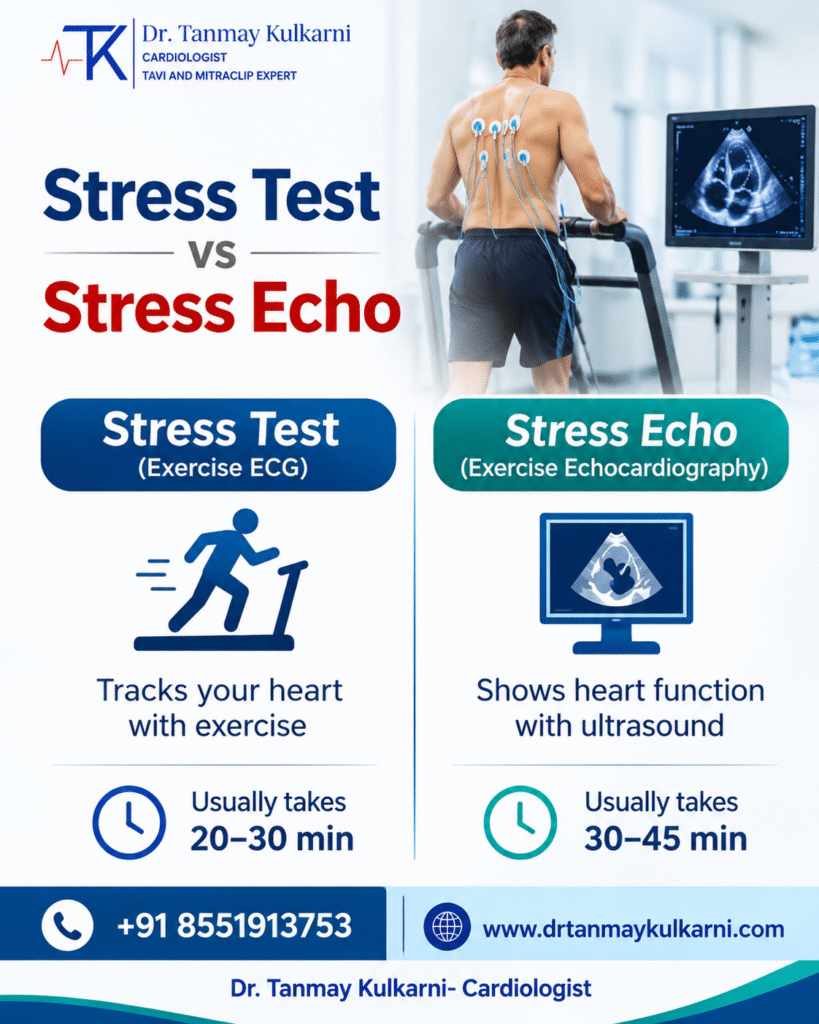
When a doctor wants to understand how the heart responds to physical activity, a stress-based cardiac test may be recommended. Two commonly discussed investigations are the exercise stress test and stress echocardiography. Although both assess the heart during increased workload, they provide different types of information.
Understanding the difference can help patients know why a particular test may have been recommended and what information it can provide.
Dr. Tanmay S. Kulkarni, Cardiologist in Baner, Pune, provides cardiac evaluation based on individual symptoms, medical history, examination findings, and appropriate diagnostic investigations.
What Is a Stress Test?
An exercise stress test, also known as an exercise ECG or treadmill test, evaluates how the heart responds when the body is physically active.
During the test, the patient exercises on a treadmill or stationary bicycle while the heart rate, blood pressure, symptoms, and electrical activity of the heart are monitored. The intensity of exercise is gradually increased according to the patient’s ability and clinical condition.
The ECG helps the doctor observe changes in the heart’s electrical activity as the heart works harder.
A stress test may be considered when evaluating symptoms such as chest discomfort, breathlessness, unusual fatigue, or reduced exercise tolerance. It may also be used in selected patients to assess exercise capacity or investigate possible coronary artery disease.
What Is a Stress Echo?
A stress echocardiogram combines exercise with echocardiography. An echocardiogram uses ultrasound to create moving images of the heart.
During a stress echo, heart images are obtained before and after exercise, or at different stages of increased cardiac workload. The doctor can then compare how the heart muscle and chambers respond when the heart is working harder.
A stress echo can provide information about heart function, heart wall movement, and certain aspects of blood flow and valve function.
It may be useful when a more detailed assessment of the heart’s structure and function is needed along with evaluation during stress.
Stress Test vs Stress Echo: What Is the Difference?
The main difference is the type of information obtained.
A conventional stress test primarily monitors the heart’s electrical activity during exercise. It can provide information about heart rhythm, exercise response, symptoms, heart rate, blood pressure, and certain ECG changes.
A stress echo adds ultrasound imaging to the assessment. This allows the cardiologist to observe the movement and function of the heart muscle as the workload increases.
In simple terms, a stress test focuses mainly on the heart’s electrical response, while a stress echo provides additional visual information about heart function during stress.
Neither test is automatically better for every patient. The appropriate investigation depends on the clinical question the cardiologist is trying to answer.
When May a Stress Test Be Recommended?
An exercise stress test may be considered in selected patients who have symptoms that occur during physical activity or when the doctor wants to understand exercise capacity.
It may help evaluate:
- Exercise-related chest discomfort
- Breathlessness during exertion
- Reduced exercise tolerance
- Heart rate response during exercise
- Certain exercise-related ECG changes
- Functional capacity in appropriate patients
The test is interpreted together with symptoms, medical history, physical examination, and other available information.
When May a Stress Echo Be Recommended?
A stress echo may be considered when the cardiologist needs additional information about how the heart muscle functions during increased workload.
It can help assess:
- Changes in heart wall movement
- Overall cardiac function
- Selected cases of suspected myocardial ischemia
- Certain valve-related conditions
- Response of the heart to exercise
Stress echocardiography can therefore provide both functional and imaging information during the assessment.
Is a Stress Test or Stress Echo Painful?
Both tests are generally non-invasive. During an exercise-based test, the patient exercises while being monitored by the medical team.
It is normal for the heart rate and breathing to increase during exercise. Some people may experience temporary tiredness, breathlessness, or sweating as they exercise.
The test is performed under appropriate medical supervision, and the exercise can be stopped if symptoms or other concerns develop.
Patients should inform their doctor about existing medical conditions, medications, previous cardiac problems, or symptoms before undergoing testing.
How Does a Cardiologist Decide Which Test Is Needed?
The decision is not based on the test name alone. A cardiologist considers the patient’s symptoms, age, cardiovascular risk factors, previous investigations, exercise ability, medical history, and the specific clinical question.
For example, one patient may primarily need an assessment of exercise-related ECG changes, while another may require additional information about heart muscle movement or valve function.
In some situations, another cardiac investigation may be more appropriate altogether. The choice should therefore be individualized rather than based on a comparison of which test is universally better.
Preparing for a Cardiac Stress Test
Preparation depends on the type of test and the instructions provided by the healthcare team.
Patients should follow the instructions regarding food, beverages, clothing, and medications. Comfortable clothing and suitable footwear are generally helpful for exercise-based testing.
It is also important to inform the medical team about any new symptoms or changes in health before the test.
Patients should not independently stop or change prescribed medications unless specifically instructed by their treating doctor.
Why Accurate Cardiac Evaluation Matters
A cardiac test is only one part of the overall assessment. The result needs to be interpreted alongside symptoms, examination findings, medical history, and other investigations when necessary.
A normal or abnormal test result does not always provide the complete answer by itself. Further evaluation may sometimes be recommended depending on the findings and the patient’s clinical situation.
This is why professional interpretation is important when deciding what a test result means and whether additional investigation is required.
Cardiac Evaluation in Baner, Pune
Dr. Tanmay S. Kulkarni provides cardiology consultation and evaluation for patients with a range of cardiovascular concerns in Pune. His clinical practice includes assessment of coronary artery disease, heart valve conditions, structural heart disease, and other cardiac problems.
Patients in Baner, Pune, who have been advised to undergo a stress test or stress echocardiography can discuss the purpose of the investigation and the appropriate testing approach during a cardiac consultation.
The choice between tests should always be based on the individual’s symptoms, clinical findings, medical history, and the information required by the treating cardiologist.
Understanding what each investigation measures can make the diagnostic process clearer and help patients participate more confidently in decisions about their heart health.